Every CRM vendor will tell you their platform has 500+ features. What they won't tell you is that you'll use maybe 20 of them. This guide cuts through the noise.
S
SimpTrav
September 1, 2025
Share:
Every CRM vendor will tell you their platform has 500+ features. What they won't tell you is that you'll use maybe 20 of them—and the 480 you won't use are inflating the price and cluttering your interface. This guide cuts through the noise to identify which CRM features actually drive revenue for travel agencies and which are expensive distractions.
The Feature Overload Problem
CRM shopping is overwhelming. You sit through demos where sales reps click through screen after screen of capabilities: AI-powered this, machine-learning that, integrations with platforms you've never heard of.
By the end, you're thinking "this does everything!"—which usually means "I have no idea what I actually need."
Here's the truth: most travel agencies use less than 10% of their CRM's features. The rest is bloatware that slows down your system, confuses your team, and costs you money.
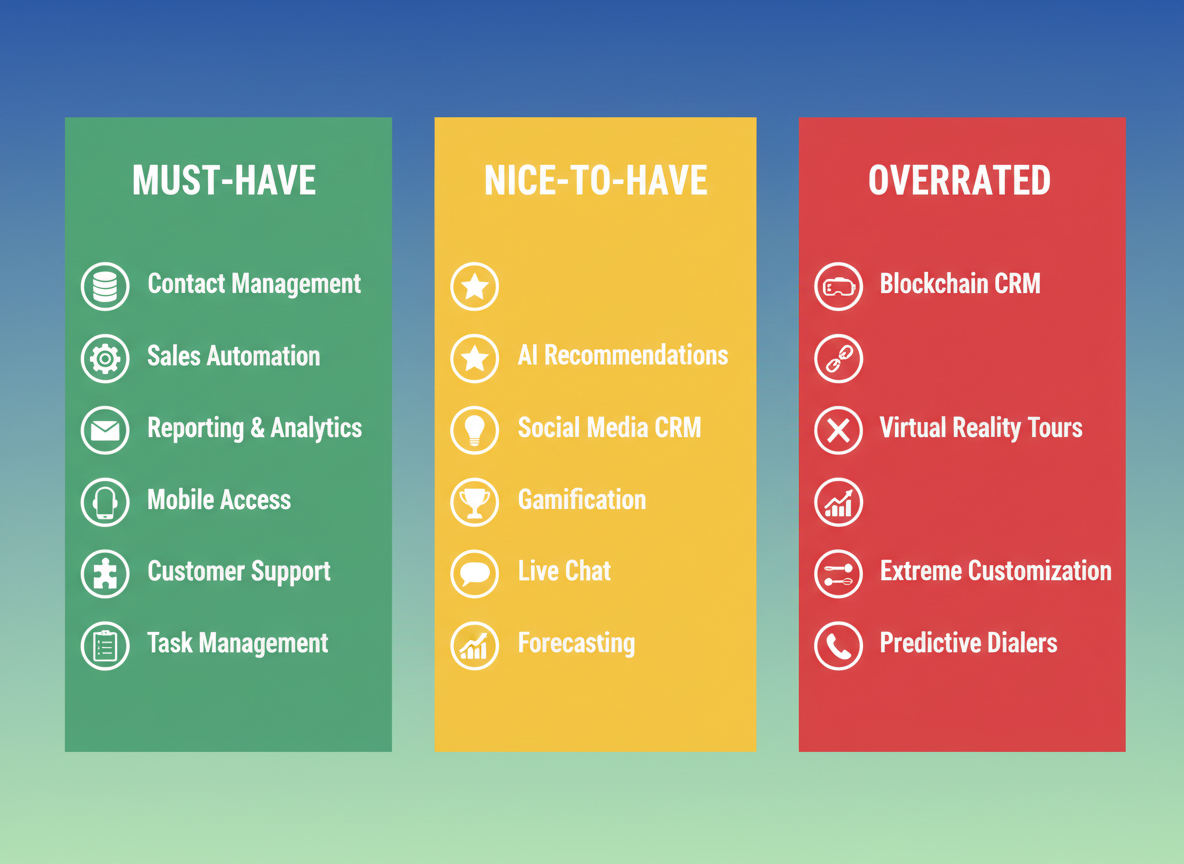
Not all features are created equal—know what matters for your business
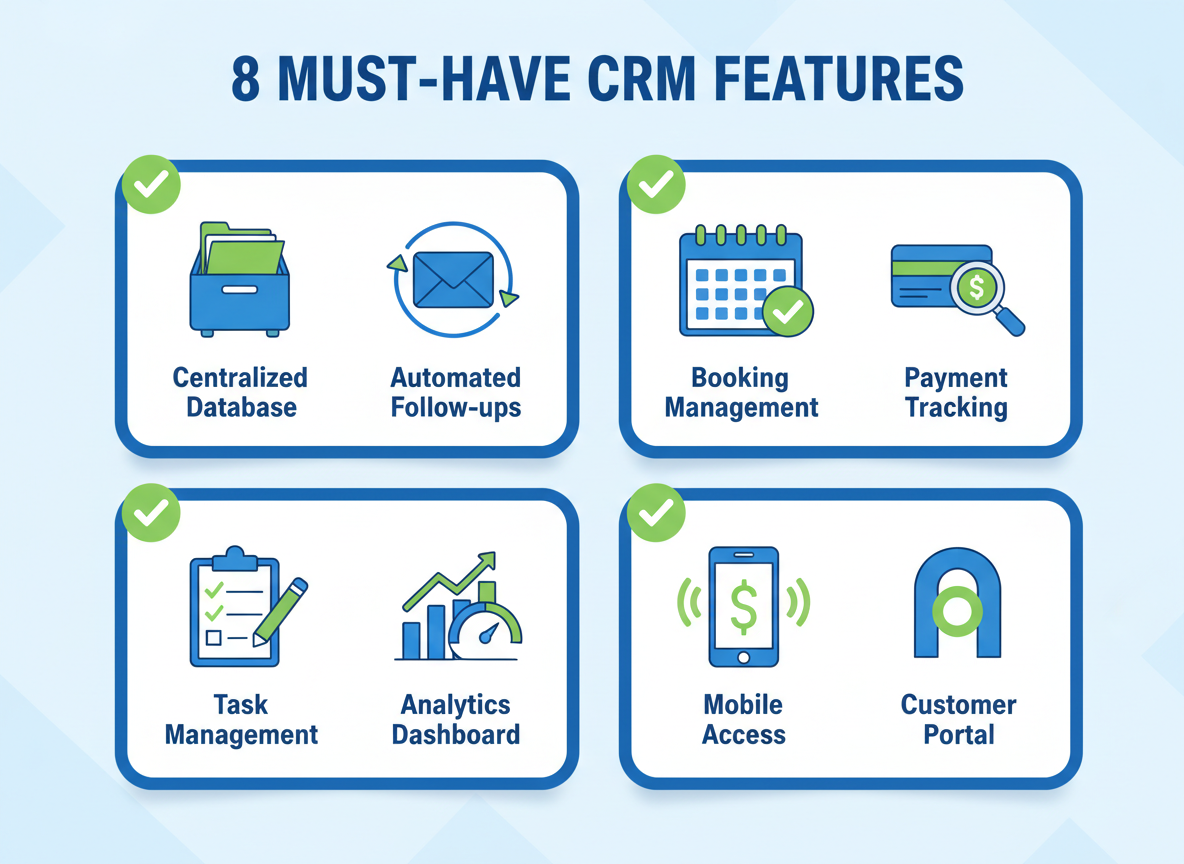
The 8 Features You Actually Need
After working with hundreds of travel agencies, these are the features that consistently drive results. If a CRM doesn't nail these, nothing else matters.
The 8 features that actually move the needle
1. Contact Management That Actually Works
What you need:
Unified customer profiles with complete history
Easy search and filtering
Custom fields for travel-specific data (passport details, preferences, loyalty status)
Duplicate detection and merging
Quick notes and activity logging
What you don't need: Social media profile aggregation, AI-powered personality analysis, automatic LinkedIn scraping. These sound cool in demos but rarely add value for travel agents.
2. Visual Sales Pipeline
What you need:
Kanban-style board showing enquiries at each stage
Drag-and-drop movement between stages
Customisable stages that match your actual sales process
Quick view of deal values and expected close dates
Filters by agent, date range, travel type
What you don't need: AI-predicted close probabilities, multi-pipeline hierarchies, complex weighted scoring systems. Keep it simple—you need to see what's hot and what's going cold.
3. Quote Builder
What you need:
Professional templates that look great
Easy itemisation of components (flights, hotels, activities)
Automatic pricing calculations
One-click PDF generation
Quote tracking (opened, viewed, accepted)
What you don't need: Complex proposal builders with dozens of template options, video embedding, interactive elements that clients struggle with.
4. Email Integration
What you need:
Two-way sync with Gmail/Outlook
Emails automatically logged against contacts
Email templates for common responses
Send and receive from within the CRM
What you don't need: Sophisticated email sequences, A/B testing, send-time optimisation. These are marketing tools, not CRM essentials.
5. Task & Follow-Up Management
What you need:
Tasks linked to contacts and deals
Due date reminders
Simple task assignment to team members
Daily/weekly task views
What you don't need: Project management features, Gantt charts, resource allocation tools. A CRM isn't a project manager.
6. Payment Tracking
What you need:
Deposit and balance tracking per booking
Payment due date visibility
Integration with payment gateways
Outstanding payment reports
What you don't need: Full accounting capabilities, multi-currency reconciliation, commission hierarchies. Connect to your accounting software for that.
7. Basic Reporting
What you need:
Sales by agent, period, travel type
Pipeline value and conversion rates
Activity metrics (calls, emails, quotes sent)
Revenue forecasting
What you don't need: 100+ pre-built reports, complex BI dashboards, data warehouse integrations. Start with 5 reports that tell you what's working.
8. Mobile Access
What you need:
Responsive web interface or native app
Access to contacts and deals on the go
Ability to log calls and notes from your phone
Push notifications for important updates
What you don't need: Offline mode with full functionality, GPS tracking, voice-to-text transcription.
Why Simpler Is Better
A simpler CRM means faster adoption and better results
There's a reason the most successful travel agencies often use simpler tools. Complex CRMs create problems:
Slower adoption: Teams resist tools that feel overwhelming. A CRM nobody uses is worthless.
Higher training costs: Every feature is something you have to teach and support.
More things to break: Complexity creates bugs, conflicts, and maintenance overhead.
Analysis paralysis: Too many options slow down decision-making.
Higher costs: You're paying for features you'll never touch.
The 80/20 Rule: 80% of your results come from 20% of the features. Focus ruthlessly on that 20%.
Features That Sound Great (But You'll Never Use)
These features dominate CRM marketing but rarely deliver value for travel agencies:
AI Lead Scoring
The pitch: "AI automatically prioritises your hottest leads!" The reality: With the volume most travel agencies handle, you can prioritise leads yourself in seconds. AI scoring adds complexity without meaningful benefit until you're handling hundreds of enquiries daily.
Social Media Integration
The pitch: "See all your customer's social activity in one place!" The reality: Rarely useful for travel sales. You need to know their travel preferences and booking history, not their Instagram posts.
Advanced Workflow Automation
The pitch: "Automate complex multi-step processes with visual builders!" The reality: Most agencies need simple automations (booking confirmations, payment reminders). Enterprise-grade workflow tools add complexity you don't need.
Territory Management
The pitch: "Assign leads by geography, industry, or custom rules!" The reality: Useful for enterprise sales teams with hundreds of reps. Overkill for a 5-person travel agency.
Advanced Analytics & BI
The pitch: "Build custom dashboards with drag-and-drop widgets!" The reality: You need 5 reports, not 500 possible report configurations. Most "advanced analytics" goes unused.
How to Actually Choose a CRM
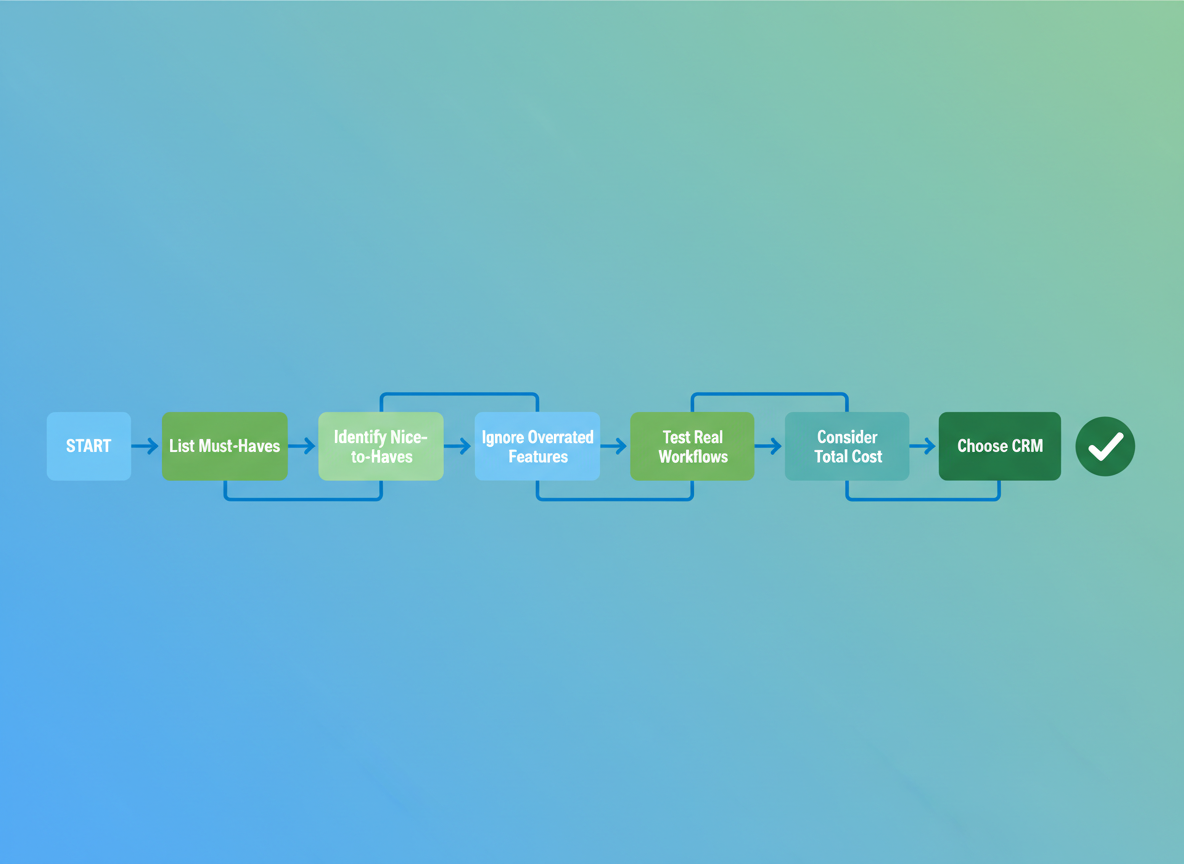
A practical framework for making the right CRM decision
Step 1: List Your Actual Workflows
Before looking at any CRM, document how your team actually works today. What happens when an enquiry comes in? How do you create quotes? How do you track payments? Map your real processes, not ideal ones.
Step 2: Identify Pain Points
Where does work fall through the cracks? What takes too long? What frustrates your team? These are the problems your CRM needs to solve—not theoretical problems vendors invent.
Step 3: Create a Must-Have List
Based on your workflows and pain points, create a short list of absolute requirements. This shouldn't be more than 10 items. Everything else is nice-to-have.
Step 4: Demo With Your Data
Don't let vendors show you perfect demo data. Import your actual customer list and test real scenarios. How does it feel to create a quote for a real client? Can you find information quickly?
Step 5: Get Team Buy-In
Involve your team in the decision—they're the ones who'll use it daily
Include your team in the evaluation. The people who'll use the CRM daily should have input on the decision. Their buy-in dramatically increases adoption success.
CRM Red Flags to Watch For
🚩 "You'll grow into the features" — If you don't need them now, don't pay for them now.
🚩 Confusing pricing tiers — If you can't understand what you're paying for, that's intentional.
🚩 Long implementation timelines — A CRM shouldn't take months to set up.
🚩 Required professional services — If you need consultants to make it work, it's too complex.
🚩 Feature-focused demos — Good vendors focus on your problems, not their features.
The Bottom Line
The best CRM isn't the one with the most features. It's the one your team actually uses, every day, to serve customers better and close more bookings.
Focus on the fundamentals: contact management, pipeline visibility, quote creation, and payment tracking. Get those right, and everything else is gravy.
Don't let feature checklists drive your decision. Let your actual workflows and pain points guide you to a tool that fits—not one that overwhelms.
See a CRM Built for Travel Agencies
SimpTrav is designed specifically for travel businesses—with the features you need and none of the bloat you don't. Visual pipeline, integrated quotes, payment tracking, and clean reporting. No enterprise complexity.
We use cookies to enhance your browsing experience and analyze our traffic.
By clicking "Accept All", you consent to our use of cookies.
Read our Privacy Policy
Wait! Don't Miss Out
Get 14 days free + a personalized demo to see how SimpTrav can transform your travel business